Auto-floor: automated variance-floor selection
memdiver auto-floor answers one question about a memory-dump corpus without
any ground truth: is the key here, and if so where — and was the shipped
variance floor set too high to find it? It emits exactly one verdict.
The central idea is a reframing. In the classic pipeline the variance floor
φ is a correctness gate: a candidate below the floor is discarded, so a
floor set too high silently drops the key. Auto-floor demotes the floor to a
search-ordering cursor. The decryption oracle you supply (an AEAD tag check,
false-accept ≈ 2⁻¹²⁸) is the only thing that decides whether a candidate is
the key. The floor only decides the order in which candidates are handed to
the oracle. Every variance-estimate error therefore costs extra latency, never
a miss.
One sentence
The oracle decides correctness; the floor only decides order. So the worst a mis-set floor can do is make the search slower — it can never hide the key.
How it works
        flowchart LR
    C[Consensus<br/>per-byte variance] --> M[Maximal candidate set<br/>entropy + alignment only<br/>floor disabled]
    M --> R[Rank by window variance<br/>best-first]
    R --> O{Oracle<br/>AEAD tag}
    O -->|accept| V[Verdict]
    O -->|reject all| V
    F[φ = p_min·σ_k²<br/>policy floor] -.orders.-> R
    F -.-> V
Build the maximal candidate set once, with the floor disabled — only the entropy and alignment gates apply. This is the set the oracle could ever be asked about.
Rank the maximal set by descending window variance.
Walk the ranking best-first, handing each distinct candidate to the oracle, until one verifies or the set is exhausted.
Emit one verdict, recording where the recommended floor
φsat relative to the hit.
The four verdicts
The key verified at or above the shipped default floor. The default would already have found it — nothing was wrong.
The key verified only below the default floor. The default would have missed it; the lowered/best-first search caught it. This automates the manual “drop the floor” workflow.
The oracle rejected the entire maximal set, under stated reachability preconditions. Qualified by a confidence = coverage × filter-recall.
A diagnostic gate failed — unhealthy oracle, coverage below --min-coverage,
exhausted --oracle-budget (reason cost), low alignment (alignment), or a
managed/moving-GC heap (regime). Never a false ABSENT.
Why ABSENT is conditional
A negative is only trustworthy if the key could have been seen. Auto-floor
returns ABSENT only when the maximal set was fully swept under established
preconditions (resident in all captures, contiguous, materialized, within
coverage, offset correspondence established). The grid caveat is
stride-dependent: at the default --stride 1 every offset in the maximal set
was enumerated, so no grid caveat is listed; raise the stride and
“key aligned to the stride=N grid” is added to what the verdict is conditioned
on. If a budget ran out, alignment was poor, or the target is a managed heap, the
verdict downgrades to INCONCLUSIVE with a reason rather than claiming absence.
Quickstart
Auto-floor consumes a finalized Welford consensus state and your oracle:
# 1. Build a consensus over your aligned dumps (Welford, incremental)
memdiver consensus-begin  --out state.json ...
memdiver consensus-add    --state state.json dump_02.raw
memdiver consensus-finalize --state state.json

# 2. Run auto-floor — one verdict, oracle-arbitrated
memdiver auto-floor \
    --state state.json \
    --reference-dump dump_01.raw \
    --oracle ./my_oracle.py \
    --p-min 0.35 \
    --output-dir ./verdict
The output directory receives verdict.json (machine-readable) and
report.md (the sweep curve, the recovered offset, and where φ sat). See
the oracle interface for how to write my_oracle.py.
The floor: φ = p_min · σ_k²
A fixed floor conflates two different things — how often a key byte is
resident across runs (p_i) and the ceiling variance of a full-entropy byte
(σ_k²). The level set {Var = φ} is a curve in that plane, not a line at a
fixed presence. To retain a key that is present in a p_min fraction of runs
you set
$$ \varphi = p_{\min}\cdot\sigma_k^2 ,\qquad \sigma_k^2 = \frac{256^2-1}{12}=5461.25 .$$
This turns the floor into a retention policy you can state in one number:
“keep any key resident in at least p_min of runs.” The shipped default
3000 silently assumes p_min = 3000/5461 ≈ 0.55; dropping to p_min = 0.35
gives a floor near the hand-tuned value analysts had been using.
σ_k² is estimated empirically from the least-diluted interior of candidate
windows (P90, clamped to [½·σ_k², σ_k²]). That estimate is only trusted once
there are enough captures: with the defaults (p_min = 0.35, presence target
k = 5) the gate is N ≥ ⌈k/p_min⌉ = 15. Below it, auto-floor falls back to
the conservative ceiling σ_k² = 5461.25.
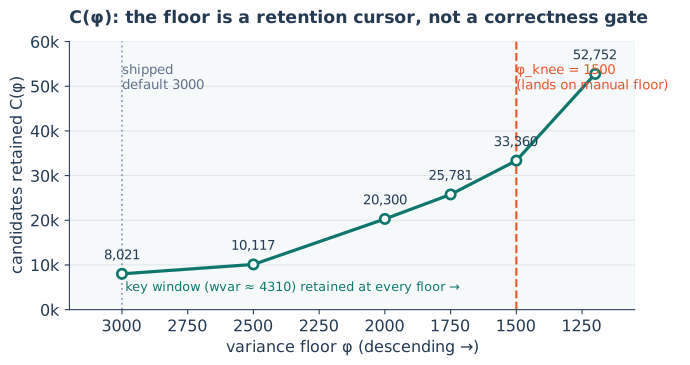
The curve above is measured on the gocryptfs corpus (N = 100). As the floor descends the candidate count grows smoothly; the key window (mean per-byte variance ≈ 4310) is retained at every floor on the ladder, including the shipped default 3000. The floor never gates the key out — it only sets how many candidates precede it in the oracle queue.
Parameter reference
Recommended floor
Flag |
Default |
Principle |
|---|---|---|
|
|
|
|
|
Retention policy: keep keys resident in ≥ |
Candidate formation
Flag |
Default |
Principle |
|---|---|---|
|
|
Comma-separated key widths to enumerate. |
|
|
Candidate grid step. The grid is absolute, so at stride N only offsets that are multiples of N are enumerated; the default |
|
|
Scan step of the block-density gate: the stride at which |
|
|
Region-formation block granularity. |
|
|
High-entropy gate: windows below the bits/byte threshold are not key-like and never enter the maximal set. |
|
|
Minimum high-entropy density for a region to survive. |
|
|
Smallest region size retained. |
```{admonition} --stride and --alignment are two different grids
- class:
important The table lists
1and8adjacently; they do not mean the same thing, and only one of them can cost you the key.
--stride is the candidate enumeration step. At --stride N only offsets
that are multiples of N are handed to the oracle, so any stride > 1 can skip the
key entirely and still report a clean no-hit. That is why the default is 1 —
full coverage.
--alignment never discards a byte for being unaligned. It is the scan step
of the block-density gate (engine/candidate_pipeline._aligned_mask, defaults
alignment=8 / density_threshold=0.5), which keeps whole blocks whose
candidate density reaches the threshold. A byte at offset 585148
(585148 % 8 == 4) therefore passes fine.
In short: --alignment coarsens where MemDiver looks; --stride 1 then
tests every offset inside what it found. Leaving --alignment at 8 costs
no coverage — raising --stride does.
### Oracle & verdict gating

| Flag | Default | Principle |
|---|---|---|
| `--oracle` | *required* | Your `verify(bytes) -> bool`. SHA-256 audited on load; no sandbox — treat like `find -exec`. |
| `--oracle-config` | *none* | Optional TOML passed to `build_oracle` for stateful oracles. |
| `--reference-dump` | *required* | The dump the oracle verifies candidate bytes against. |
| `--self-test-trials` | `8` | Random-negative probes proving the oracle rejects noise and is deterministic. Each costs one call — lower it for rate-limited/one-shot oracles. |
| `--positive-control` | *none* | Hex of a known-good key; adds one self-test call that must *accept*. |
| `--oracle-budget` | *none* | Cap on total oracle calls. Exhausting it yields `INCONCLUSIVE(cost)`, **never** a false `ABSENT` — the safe verdict for expensive oracles. |
| `--coverage` / `--min-coverage` | *none* / `0.80` | Cross-run coverage C∩. Below `--min-coverage` ⇒ `INCONCLUSIVE(coverage)`; otherwise qualifies the `ABSENT` confidence. |
| `--filter-recall` | *none* | Entropy/alignment filter recall; the second factor in `ABSENT` confidence = coverage × recall. |
| `--correspondence` | *none* | Reported offset-correspondence score in [0,1]. |
| `--alignment-quality` / `--min-alignment` | *none* / `0.5` | Per-region alignment quality; below the minimum a no-hit is `INCONCLUSIVE(alignment)`. |
| `--managed-region` | off | Flags a managed runtime / moving-GC heap: a no-hit is `INCONCLUSIVE(regime)`, since off-grid object headers can hide the key. |

## Offline research harness (zero oracle calls)

Two scripts under `scripts/` let you *measure* the floor machinery on a corpus
with a **known** key offset, without ever calling an oracle — useful for
validation and for deciding whether a richer ordering is worth building.

```bash
# Build a flat-VAS consensus (variance.npy + reference.bin + meta.json)
python scripts/build_gocryptfs_consensus.py \
    --dataset /path/to/dataset_gocryptfs --n 100 \
    --emit-halves \
    --out artifacts/consensus_n100

# Score it offline: maximal set, R_var, R_composite, φ-selection (+ A3 if halves)
python scripts/phase_a_experiment.py \
    --consensus-dir artifacts/consensus_n100 \
    --key-offset 0x57a220
R_var is the number of oracle calls a plain descending-variance sweep would
need to reach the key — computed as a count, with zero oracle calls. It is
the offline mirror of the live sweep length. --emit-halves additionally
writes the complementary-half variance arrays used by the experimental
subsample-stability instrument (below).
Validated on real data (gocryptfs, N = 100)
Rebuilding the consensus over 100 captures and scoring it offline (zero oracle calls) reproduces the maximal set exactly and sharpens every floor estimate:
Quantity |
N = 20 |
N = 100 |
|---|---|---|
Maximal candidate set |
115,635 |
115,635 |
σ_k² (P90 interior) |
4,578 |
3,023 |
φ_theory(0.35) = 0.35·σ_k² |
1,602 |
1,058 |
φ_theory(0.55) |
≈ 2,518 |
1,663 |
φ_knee (descending Kneedle) |
2,500 |
1,500 |
key retained at φ_knee / default 3000 |
— |
✅ / ✅ |
At N = 100 the empirical knee lands exactly on the analysts’ hand-tuned floor of 1500, and the policy floor and the knee bracket the manual region (φ_theory(0.35) = 1058 … φ_knee = 1500 … φ_theory(0.55) = 1663). The key window is retained at every floor. A principled floor is recoverable as a policy, not a fitted valley.
What does not help (and why)
These are honest negatives — measured, and deliberately not load-bearing. They are recorded here rather than in the paper because they argue against building things.
A richer ordering statistic barely helps. Re-scoring the maximal set with a single-capture uniformity gate (min-entropy, byte-uniformity χ², low autocorrelation) before ranking by variance demotes only structured clutter. Measured:
R_composite = 6,972vs the variance baselineR_var = 7,179— a 2.9 % reduction. The remaining outranking candidates are per-run-fresh uniform clutter (5,593 at the ceiling) that is statistically identical to the key on any single-capture statistic. Only the oracle can pass it. Ordering is not the lever.Data-driven valley-fitting (
--phi0-method otsu) is unstable. On the gocryptfs consensus the high-variance component has no clean valley, so the Otsu edge estimate lands near 7730 and clamps to the default 3000 — a floor that would miss the key. The policy floor (pmin) is stable where the valley fit is not;otsuis kept only as a selectable comparison.The persistence-vs-freshness discriminator does not apply here. Telling a persistent key (recurs across runs) from a fresh nonce works only when the same secret is captured repeatedly. In this corpus every run uses a different password, so the key is fresh-random per run and the discriminator is inapplicable. It applies to same-secret corpora.
The key is not “low-variance.” The mixture model predicts diluted keys sit below fresh clutter; here, because each key is fresh per run, the key window is high variance (mean ≈ 4310–6060). The “floor too high” effect at N = 20 was an enumeration/region-formation boundary effect, not a window-mean collapse.
Experimental: subsample stability
Experimental — needs further research
The instrument below is not a shipped default and not a validated result. It is recorded as a direction, measured once at N = 100.
The sample-variance relative error over m observations is ≈ √(2/(m−1)). At
N = 20 (m ≈ 10 per half) that is ≈ 0.47 and swamps any signal; only at
N ≳ 100 (m ≈ 50, ≈ 0.20) does variance stability become informative. The
subsample-stability instrument splits the captures into two complementary
halves (--emit-halves), computes per-byte variance on each, and scores every
candidate window by how closely the two halves agree — rewarding windows that
are high-variance and stable.
Measured at N = 100: the key window’s cross-half agreement (rel-err 0.212)
matches the theoretical scale (0.202) almost exactly — confirming the regime is
finally large enough for the signal to exist. The stability-aware ranking gives
R_stable = 6,660 vs R_var = 7,179 (a 7.2 % reduction — more than the
uniformity gate’s 2.9 %). It is a real, if modest, gain that grows with N, but
it remains far from oracle-competitive: on a per-run-fresh-clutter target,
stability cannot rank the key first. Whether it becomes useful on same-secret
corpora, or at N ≫ 100, is open.
See also
Oracle interface — writing the
verify()your auto-floor run needs.CLI reference — the full
memdiver auto-floorflag list.Dataset layout — how captures are organized for consensus building.